3. Tilt-Up Wall Structural Analysis
The tributary width for loads can be taken as the width of the strip plus one-half the width of adjacent openings.
Joist loads are divided between the individual legs assuming an equivalent simply supported beam across the top of the panel with the supports at the centerline of each leg.

The calculation of maximum factored wall forces in accordance with 11.8.3.1 including moment magnification due to second order (P-Δ) effects is shown below (load combination U = 1.2 D + 1.6 Lr + 0.5 W is considered in this example):
ACI 318-14 (Eq. 11.8.3.1(d)) Where Mua is the maximum factored moment at midheight of wall due to lateral and eccentric vertical loads, not including PΔ effects. ACI 318-14 (11.8.3.1) ACI 318-14 (19.2.2.1(b)) ACI 318-14 (11.8.3.1(c)) ACI 318-14 (11.8.3.1) Calculate the effective area of longitudinal reinforcement in a slender wall for obtaining an approximate cracked moment of inertia. ACI 318-14 (R11.8.3.1) The following calculation are performed with the effective area of steel in lieu of the actual area of steel. ACI 318-14 (R21.2.2) ACI 318-14 (Table 21.2.2) ACI 318-14 (11.8.3.1(c)) ACI 318-14 (Eq. 11.8.3.1(d))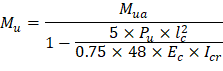

3.3. Tension-controlled verification
ACI 318-14 (11.8.1.1(b)) Therefore, section is tension controlled ACI 318-14 (Table 21.2.2)